About CSSM
Description of mission / research objectives / organizational goals.
3 Pillars -> Information on CSSM's ability to develop solutions in food security, climate change and clean water.
Description of mission / research objectives / organizational goals.
3 Pillars -> Information on CSSM's ability to develop solutions in food security, climate change and clean water.
Work is well underway on ForestSHARE, the Forest Soil Health Assessment, Research, and Extension program for Nova Scotia. This project helps woodlot owners better understand their forest soils by developing baseline ranges for different soil properties and management interpretations for different forest types across the province.
The ForestSHARE team has been busy preparing for a three-year soil sampling effort that will gather information from 850 forest sites across Nova Scotia. The program is already gaining momentum, with enthusiastic participation from local forestry professionals and woodland owners who want to better understand what’s happening beneath their feet.
Next up: we will be analyzing the first wave of soil samples, training more samplers, and reviewing research from other regions to help interpret the results.
Healthy soils grow healthy forests. By working together, we can build stronger, more resilient forests for the future. Throughout this project, we will provide updates here about different aspects of the work.
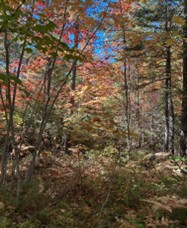
Forest soils are shaped by their environment, everything from the underlying geology to the plants growing above. That is why we are using ecosites to guide our sampling locations. Ecosites are distinct units of land which share similar moisture and nutrient conditions. The land units may have formed under different environmental influences, but the soil and growing conditions within an ecosite fall within a certain range. Each ecosite supports a predictable group of vegetation types that naturally grow in those conditions. Ecosites for Nova Scotia are outlined in the Forest Ecosystem Classification (FEC) system.
By selecting sampling locations based on ecosites, we are making sure that we capture the diversity of forest soils across the province. This allows us to ask more meaningful questions, like: How do soil conditions differ between a Dry-Poor / White pine–Oak ecosite and a Moist-Rich / Sugar maple–Yellow birch ecosite?
To make sure we get a complete picture of forest soil health, we are selecting sampling points using predictive ecosystem mapping (PEM). These maps predict what type of ecosystem is found in different areas, based on aerial photography interpretation. We then group those areas into ecosites using Nova Scotia’s FEC system. Some ecosites cover large parts of the province, while others are more rare. To get a better representation, we will take more samples from common ecosites and fewer from those that cover less land, while still collecting at least 30 samples from each one.
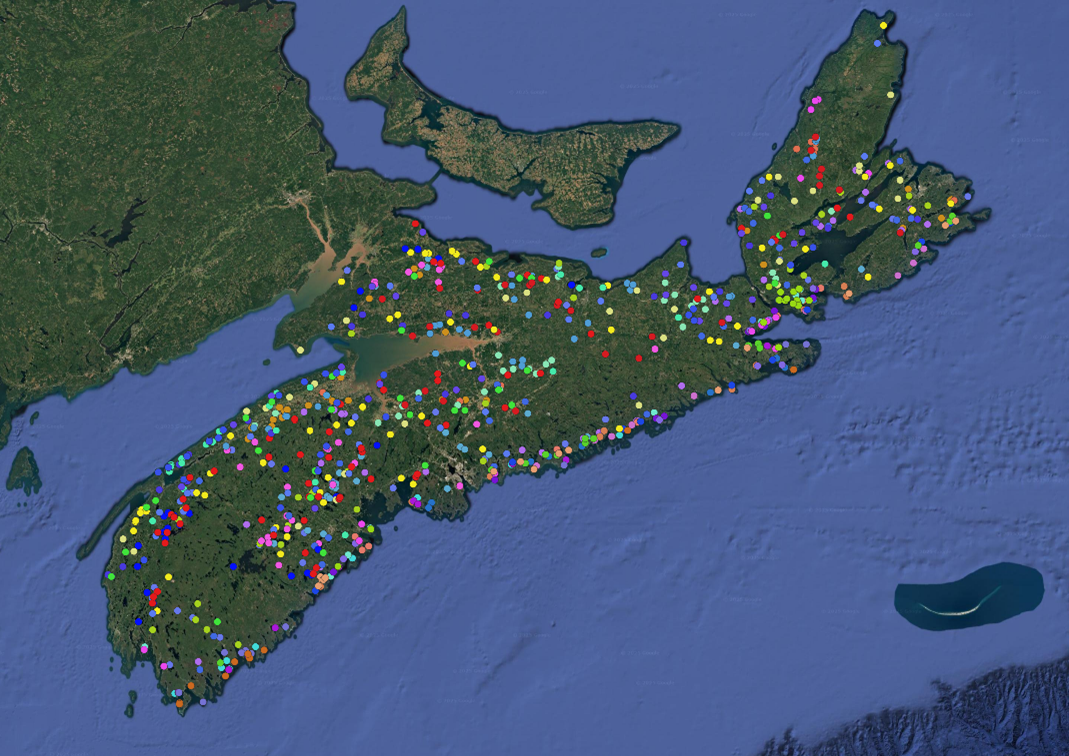
We are also using a random sampling approach with a tool that helps distributes points across the province. This helps avoid clustering too many samples in one area, giving us a better overall picture of soil and climate conditions across Nova Scotia’s forests.
This careful approach means the results should reflect the variety of soils across private woodlands in Nova Scotia and help develop practical, site-specific recommendations for different types of forest land.
This project is a collaboration with Murray A. Reeves Forestry, the Family Forest Network, Dalhousie University, the Department of Natural Resources, Nova Scotia Community Colleges, and Genome Atlantic.
For more information, please reach out to:
Caitlin McCavour: caitlin.mccavour@dal.ca
Kevin Keys: kevinkeys.ffn@gmail.com
Debbie Reeves: debbie.reevesforestry@gmail.com